ISO Compliance in the UAE: Everything Businesses Should Know
Why Uae Businesses Are In A Rush To Get Iso Certified In 2026Walk into almost any procurement conversation in the UAE this moment and ISO certification is mentioned within a matter minutes. What used to be an option for larger companies has turned into a normal expectation for everyone in construction, logistics, healthcare food production, as well as technology. The speed at which local firms are exploring certification has increased substantially over the past few years.Government Contracts Drive Much of the demand
A large part of the new push is derived directly from semi-government and public tendering requirements. Many public sector contracts across the Emirates include a valid ISO certificate as a mandatory prequalification documentation rather than an optional extra, which means companies without one are generally not allowed to bid before price or ability even get into the fray.
International Trade Partners Expect It as a Standard
The UAE's status as the regional logistics and trade hub implies that a significant percentage of local businesses work with international partners. These clients increasingly see ISO accreditation as a crucial assurance rather than a distinguishing factor. An European or North American buyer evaluating a suppliers based in Dubai will typically shortlist according to whether the recognized management system certificate exists, since it is a trusted standard to refer to regardless of their knowledge of the local market.
Free Zones are actively encouraging the Certification
Several of the UAE's major free zones have started promoting certification as a part of their business set-up packages as they recognize that tenants who have been certified tend to have better clients and expand faster. This type of encouragement from the institutions, along with real competition pressure, has made certification an elite consideration to become something like standard business hygiene.
The Risk and Insurance Considerations Are In a Increasing Role
Insurers operating in the UAE industry are increasingly considering management system certification into their risk assessments, particularly for sectors like manufacturing and construction where safety and quality failures create significant liability risks. A certified quality or safety management system gives insurers the evidence needed to justify the pricing of risk. A few offer more favorable rates to those with certifications due to this.
The Cost of Certification Has Slowed
The growing competition among certification companies and consultants working in the UAE has reduced prices substantially compared to a decade earlier, making certification available to small and medium businesses that were previously just for large corporates. The decrease in costs has opened the door to many more companies that want to get certified for the first time.
Different Standards Suit Different Businesses
Different businesses may require the same certificate and figuring out what standard actually is the first hurdle. A construction firm's concerns around security management can be quite different to a software firm's requirements concerning information security. This is why there is a growing demand throughout a variety standards, rather than focusing on only one.
What does this mean for businesses? Still waiting to be able to make a decision
If companies are still trying to decide whether certification is worth considering and what the real-world situation is in 2026 is that the focus has moved from whether rivals have it to how many possibilities are missing with it. Beginning with a gap analysis against the relevant standard. It's which is followed by a formal phase of implementation prior to an external audit. The entire process is a lot easier to follow than even five years ago.
The Talent Market is Not Responding
Certification has become important to how UAE firms operate, the local talent market is developing around quality the environment and safety areas, with more people possessing lead auditors who are recognized and Implementation qualifications than previously. This has made it significantly easier for companies to bring on internal personnel capable of sustaining the management system following the certification program closes, rather than using external consultants for the duration of time.
Multinational Companies Set the Regional Tone
Many of the multinational companies operating local or Middle East headquarters out of the UAE have global regulations for certification and they expect local suppliers and suppliers to comply with the same standards. This has a definite consequence, as local companies that supply to these supply chains by multinational companies frequently find certification requirements cascading down from expectations for clients that originate well outside the UAE itself.
Certification is increasingly viewed as a Growth Enabler, It's Not Only Compliance
The most notable shift in attitude over the past few years is the fact that more UAE firms now see certification as something that allows growth by opening opportunities for tender eligibility as well as international partnership opportunities instead of viewing it purely as an expensive compliance expense. This has made the certification process much easier to justify internally, as it links directly to revenue growth opportunities rather than being simply a part of the compliance budget.
What to Expect in the Years in the years ahead
Based on the current state of affairs given the current situation, it's reasonable expect ISO certification will remain a competitive edge to a full entrance requirement into the many UAE sectors over the next years. Companies that are able to anticipate this evolution now, rather than holding off until certification becomes mandatory generally find the process considerably less stressful, and the competitive positioning considerably stronger.
How long will the whole process is typically
The full journey beginning with the gap assessment and ending with certificate issuance typically takes anywhere between three and nine months based on the scale of business and current process maturity and the speed at which internal teams are able implement adjustments. Businesses that are under pressure to meet deadlines frequently try to shorten the timeline considerably, but rushing the implementation process can create a management system that struggled at the first check, making a more realistic timeline a really worthwhile investment.
In the end, the soaring demand for ISO certification in the UAE will show that the market has grown up beyond focusing on safety and quality as a personal preference and began to view it as an essential aspect of doing business with a serious attitude, both locally as well as internationally. If you are a business looking to start, the practical next step is an honest conversation with an accredited certification body or consultant on which standard can meet the current demands and expectations, rather than merely guessing the competition's standards based on what will display on their websites. There are no any signs of slowing and makes the present period a good time for companies who are still considering certification to move from consideration to taking action. Read the top rated ISO Certification UAE for blog examples.
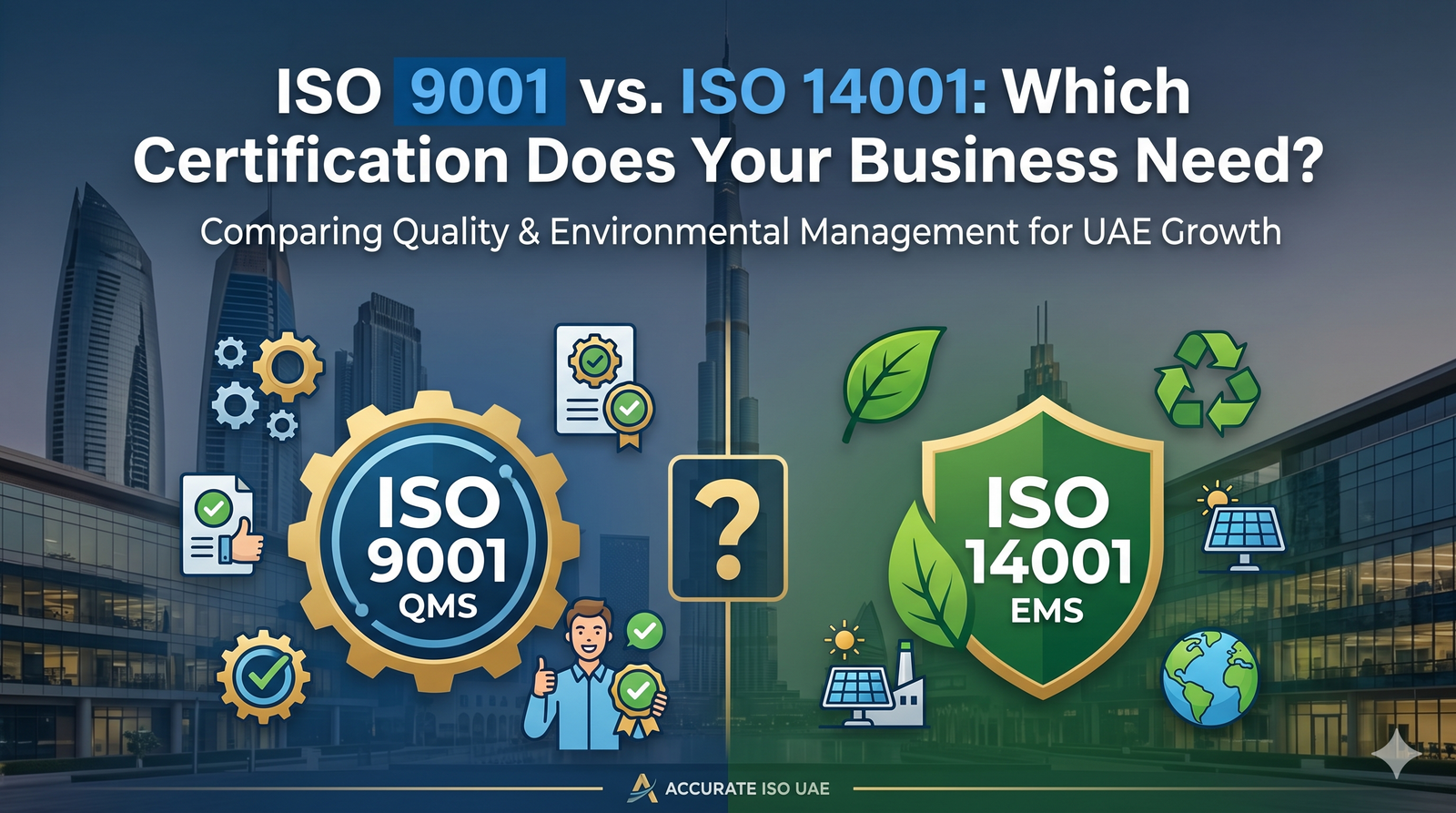
ISO 14001 Certification How Iso 14001 Certification Matters? Environmental Management Is Important To Uae Companies
Environmental considerations have moved beyond being a peripheral concern to a major business issue across the UAE with the help of government sustainability initiatives and partly through the rise of regulatory and customer expectations. ISO 14001, the international standard for environmental management systems has evolved into a natural choice for businesses that want to show genuine, structured environmental responsibility and not just good plans alone.What ISO 14001 Actually Requires
The standard calls on businesses to determine the environmental impacts associated with their operations, learn how they impact on their environment, and implement strategies in place to control and limit negative effects over time. This could range from controlling emissions and waste when working in a factory to reducing energy consumption and paper use in an office-based service business, since the standard is based on the exact environmental footprint of a business. footprint appears to be.
Alignment with UAE's National Sustainability Goals
The United Arab Emirates' broader commitments concerning sustainability and net-zero goals have created genuine institutional momentum that supports environmental management. ISO 14001 certification gives individual businesses a way of demonstrating their alignment with these bigger goals. It is more important to align with companies that are bidding on government and semi-government projects, where environmental credibility is now becoming an explicit evaluation criteria.
Industries Where It Matters Most
Construction, manufacturing oil and gas and logistics generally face the greatest environmental scrutiny, due to the magnitude of their operations. However, service-based firms are increasingly trying to get certification too, both for tender qualification and cost savings by utilizing the use of resources more efficiently. Even companies with a small environmental footprint typically find the structured approach reveals unexpected efficiency advantages.
The Legal Compliance Angle
A large portion of ISO 14001 involves identifying and the monitoring of compliance with applicable environmental laws and regulations, which in the UAE context, covers federal environmental legislation as well as regulations specific to the emirates. Certified companies typically have a more precise, current understanding of their regulatory obligations than their competitors who are not certified, and reduce the risk of accidental violations and the associated penalties.
Integration With Other Management Systems
Many UAE companies that are pursuing ISO 14001 already hold or are in the process of obtaining ISO 9001, and the two standards have the same structural features that an integrated control system that covers both standards is often more efficient when compared to treating them like distinct projects. This method of integration reduces duplicated documentation and auditing effort significantly for companies that manage multiple certifications.
What the Certification Process Should Look Like
As with other management systems standards certification follows a planned method: a beginning gap evaluation, implementation of necessary processes and documentation the internal review, then an external audit carried out by an accredited certification body. Ongoing surveillance audits, typically every year, verify that the environmental management system's proper maintenance instead of reversing the process after the initial certificate is issued.
More Benefits for Business than the Certificate
Beyond the eligibility for tenders and regulatory clarity, businesses that implement ISO 14001 properly often uncover real cost savings by implementing greater efficiency in waste and resource management, alongside reputational benefits with increasingly environmentally conscious clients and business partners. These practical benefits are part of the reason why eco-certification has evolved beyond a simple compliance-driven requirement for many UAE firms.
Assessing What's Actually Important
A well-implemented ISO 14001 system focuses measurement efforts on the environmental aspects that are crucial the most to a particular company rather than focusing on parameters solely for the sake of being easy to gauge. A logistics company might prioritise the consumption of fuel and the efficiency of routes for example, whereas a manufacturing enterprise might concentrate more on wastewater production and use in order to determine where each business's actual environmental impact is.
Engagement with Suppliers and Contractors
Many UAE companies find that a meaningful share of their overall environmental impact comes from contractors and suppliers in addition to their own operations. ISO 14001 encourages businesses to be aware of this wider supply chain impact, rather than thinking of environmental management as just an internal matter. It has led some certified UAE companies to start asking their suppliers directly about ways to reduce their environmental impact, and resulting in gradually ripple effects through suppliers in the supply chains local to them.
Emergency Preparedness Is Part of the Standard
ISO 14001 requires businesses to consider the possibility of environmental emergency situations relevant to their operation, such as chemical spills and equipment failures that can have environmental consequences and have effective preparedness plans for responding to such situations instead of handling emergencies in a reactive manner. This component of preparedness is often revealed problems that the business hasn't previously looked at, specifically in regards to staff instruction for situations of emergency.
A Standard that Rewards True Resilience
In the end, ISO 14001 rewards businesses who treat environmental management as an ongoing, operational necessity rather than a documentation exercise that is completed only once and then forgotten. UAE businesses that incorporate the ISO 14001 principles into their daily decisions, instead of putting it as an independent compliance function are likely to reap the most positive environmental and reputational advantages in the course of time.
Water Management deserves special attention in the UAE Setting
Given the UAE's arid climate and dependence on desalinated freshwater for drinking water, managing and using water frequently require special attention in the ISO 14001 system compared with areas where water scarcity is less pressing. Companies that incorporate water efficiency into their environmental management system from the outset tend to identify this as one of the beneficial aspects of certification in the local environment.
For UAE businesses weighing up ISO 14001, the certification is both a response the genuine pressures from regulatory and market pressures as well as a chance to control environmental impacts better, which increasingly is a concern for regulators, clients and the UAE's sustainable development goals across the nation. As environmental expectations across the UAE continue to increase businesses that are able to build real environmental management capability now, rather than waiting for it to become a mandatory requirement, will benefit from a much better position in the years to come. None of this needs to be a burden for small businesses as the scales of standardization proportionately, and even modest effective environmental measures implemented consistently are likely to impress auditors much more than a lofty plan that isn't followed through. Consistency, more so than goal-setting alone, is what auditors and true positive environmental outcomes alike reward. small, gradual changes tend over ambitious goals that seem to stall in the initial few months. Read the recommended ISO Certification UAE for more tips.